The Product · macOS · Native
Mardo
The native Markdown viewer for Mac. Free to view, forever.
Mardo is the one thing Floof Logic wants everybody to use. It renders Markdown natively in Finder Quick Look, opens files far larger than an editor should tolerate, and follows the edits AI tools make to the file you are reading, all on ordinary local files with no vault, import step, or account.
- Viewport-first, bounded rendering. File size never becomes UI size. Mardo draws the viewport and keeps rendering bounded, which is why a 50 GiB file opens in 124 ms and every jump into it draws in under 13 ms.
- Quick Look is the front door. Select a Markdown file in Finder and press Space. Tables, code, diagrams, and math render natively, and you can select and copy text without opening a window.
- Follow Live Edits. When Claude Code, Codex, or any other tool saves the file, the exact changed ranges wash in place while your selection, caret, and viewport stay put. There is no full-document reload flash. Timewarp lets you move through the versions the file reached while it was open.
- Still just a file. Ordinary local
.mdfiles. No vault, no import step, no proprietary workspace, no mandatory account, no built-in chatbox. Unfamiliar constructs stay visible as source, and viewing never rewrites the document. - Token estimates without a model call. The status surface estimates tokens alongside the familiar document measures, without uploading anything.
- Free viewer, optional Pro. The viewer is free with no time limit. Mardo Pro adds editing and deterministic PDF export for US $29.99 once, as an offline certificate with no account, subscription, activation, or telemetry.
Open Source · Systems Software · C11
FloofClaw
A tiny C runtime for durable AI agents. Every consequence leaves evidence you can replay.
FloofClaw is not another chatbot loop. It turns messages, timers, API calls, and worker results into inspectable event-driven runs that survive restarts and keep moving until no work remains. The novel part is not merely that it is small: FloofClaw gives long-lived agent work a deterministic, durable, accountable substrate without hiding the machinery behind a framework.
- The filesystem is the database. There is no PostgreSQL, SQLite, Redis, or vector database to stand up. Append-only event logs are the truth; state files are rebuildable projections. After a crash or restart, FloofClaw replays the evidence and continues.
- A small kernel walks policy instead of owning it. A "floop" declares ordered, event-gated steps; the C kernel validates envelopes, runs jobs, appends events, and waits for their consequences. It is the walker, not the judge, so behavior stays visible in profiles, agent packets, and action contracts. A quiet supervision review uses exactly one model call.
- Every model call is a glass box. Requests, responses, token records, cache boundaries, action calls, events, and stderr artifacts are inspectable on disk. Runs can be viewed, replayed, costed, and traced instead of disappearing inside an orchestration service.
- Agents are first-class operators. Every public command speaks JSON or JSONL by default. Paste an MCP server map and FloofClaw generates ordinary actions from its catalog rather than embedding an MCP client, so the same allowlists, timeouts, disable switches, and per-call artifacts still apply.
- Native C all the way down, tested like a runtime. The package-manager-linked all-adapter core is about 544 KiB; the downloadable macOS executable is about 4.34 MiB because it carries static OpenSSL. The 42,665-line C11 codebase runs the same CLI on macOS, Linux, and Android ARM64, with 41 unit tests and 192 integration tests in its routine offline gate plus sanitizer, fuzz, chaos, disk-full, read-only, and thrash campaigns.
Systems Software · Android · Proprietary Technology
Blackwall
A complete AI development environment, built into Android from first principles.
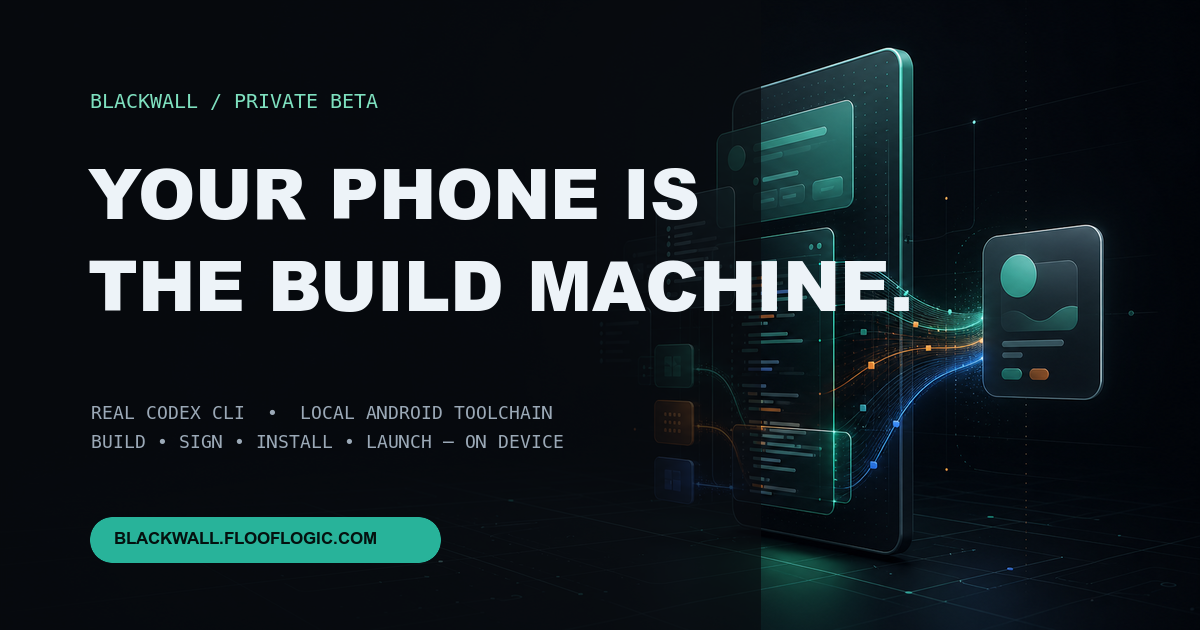
Blackwall starts where terminal emulators stop. It is a native Android shell written from scratch around an OpenGL ES terminal renderer and real PTYs, then extended into a durable control surface for Codex, Claude, and raw shell work. It can provision a focused Android app-building toolchain or a complete Debian/npm/Gradle environment. The phone itself edits, compiles, signs, installs, and launches the result.
- A shell written for this job. Blackwall's OpenGL ES renderer sits over real PTYs; it is not a WebView, a remote console, or a themed wrapper around somebody else's terminal. Keyboard-aware layout, one-to-one touch scrolling, text selection, direct terminal input, chat-style composition, voice transcription, and optimistic Send feedback are native parts of the shell.
- Multiple AI CLIs as durable work, not disposable chats. Codex, Claude, and raw shell sessions can be started, switched, disconnected, and resumed; tmux-backed durability keeps long-running AI work alive. Blackwall only interrupts with a notification when the agent actually needs input or Android needs an install decision.
- A complete environment, not an app-generator endpoint. App Builder includes the official Codex CLI, Node, OpenJDK/Java 17, Android API 35, and build-tools 35.0.0. Full Environment adds Debian, npm, Gradle 8.10.2, Claude, OpenSSH, and the freedom to install the dependencies a real project needs.
- The build remains local. There is no Floof Logic build farm, package mirror, credential relay, or proprietary dependency gate between the prompt and the APK. The project, toolchain, compilation, packaging, signing, and installation run on the device; AI inference and public downloads still use their normal upstream services.
The time numbers are proof of the architecture, not the point of it. In a measured clean App Builder trial, a fresh Blackwall install reached a generated, launched app in 15 minutes 41 seconds. On a physical Pixel 10 Pro, the plain-English notes prompt became an installed and launched app in 6 minutes 24 seconds. Blackwall is interesting because the same environment can keep going after that first APK. It is the machinery underneath Wishware and is not sold as a separate product.
Mobile AI · iOS · Project One · 2023
Barkimedes
In 2023 we put a 1.4 GB language model inside an iPhone and turned it into a dog.

One of the earliest fully local generative-AI characters on iPhone. RWKV generation, Whisper recognition, RNNoise denoising, local speech, 19 character animations, camera-responsive color, and motion-responsive depth—all shipped as one App Store product.
HCI Research · Input Design
The One-Handed Keyboard
The Schwem-Dante Layout (SDL): a reference design for one-handed, gesture-based text entry.

Text entry is one of the oldest problems in human-computer interaction, and one-handed text entry is its hardest corner — accessibility, mobile, and wearable contexts all demand it, and nothing standard serves it well. The SDL is our answer: a from-scratch layout and gesture system designed around what one hand can actually do.
- A designed layout, not a squished QWERTY. The SDL rethinks key arrangement and gesture vocabulary from first principles for single-hand ergonomics, rather than cramming a two-handed layout into half the space.
- Published research. The design ships with a full whitepaper and layout diagrams — assumptions stated, trade-offs argued, diagrams included. It's a reference design others can build on.
- Interactive proof. A live animated demo shows the layout and gesture flow in the browser, so the design can be evaluated by feel, not just by reading.
Systems Software · Infrastructure · Private Beta
Project Vellum
Your own GitHub—without a separate web server.
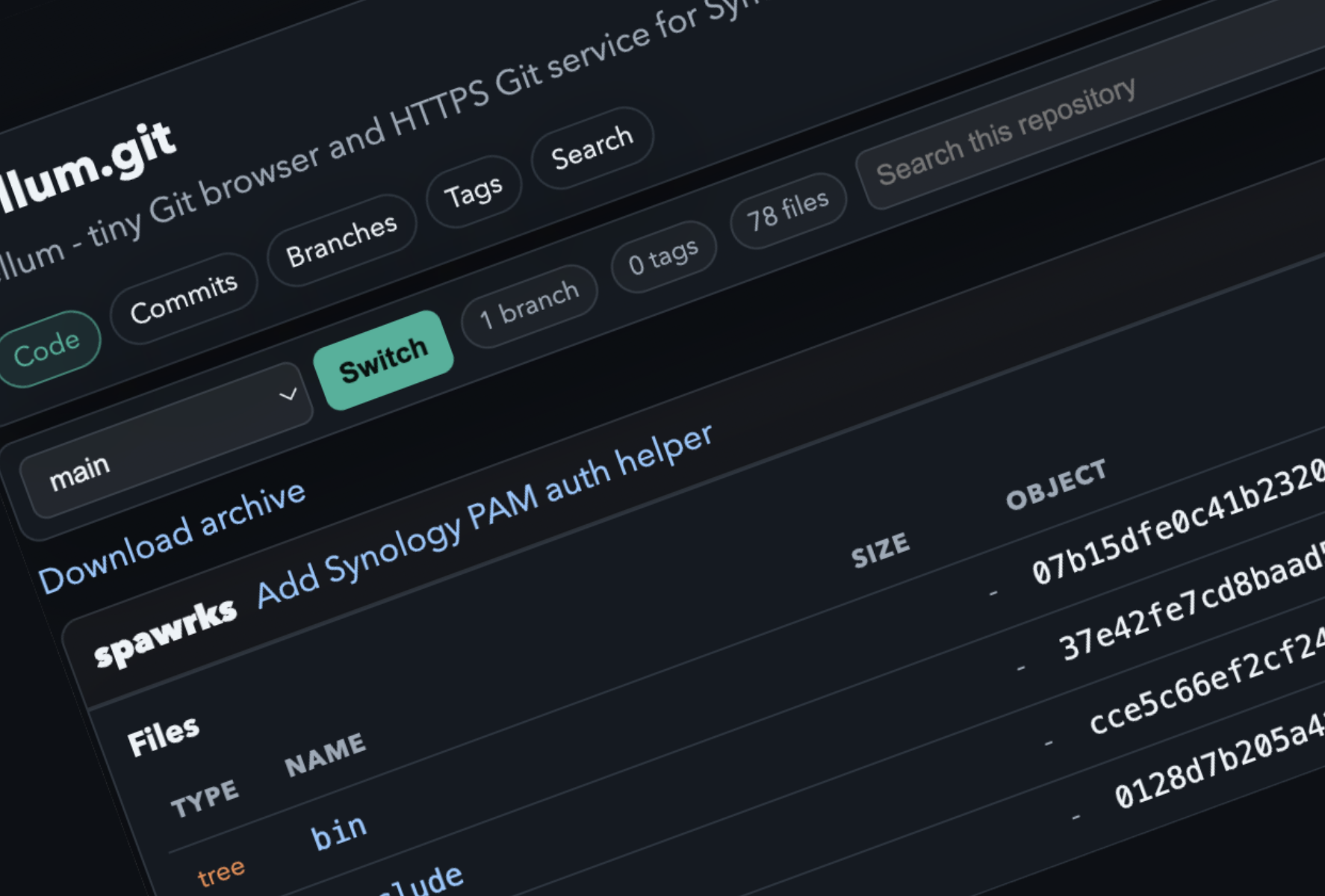
Vellum is your own private GitHub—without a separate web server. No nginx, no Apache, no application stack: one focused C service serves the browsing UI and speaks Git smart HTTP directly. Script-assisted installation and upgrades keep it low-overhead to deploy, maintain, and use. It's the infrastructure Floof Logic itself runs on—our repositories live on Vellum.
- No separate web server, period. Vellum is the server. Built on libwebsockets with a bundled OpenSSL LTS runtime, it speaks Git smart HTTP for clone, fetch, and push over the same URLs you'd expect from a hosted service—straight from the binary to your repositories.
- Serious authentication. System-native PAM login, group-based read/write authorization, and staged per-repository access policies — real multi-user permission machinery, not a password in a config file.
- Novel TLS architecture. Public access flows through a custom TCP relay so Vellum terminates its own TLS end-to-end — Cloudflare provides DNS only, never sees traffic, and certificates renew automatically via DNS-01 with a minimally-scoped API token.
- Low-overhead to operate. Script-assisted installation and upgrades from release bundles, built-in health checks, bounded logs, certificate checks, and rollback keep routine maintenance small and predictable.
Games · Browser · AI-Assisted
Floof Arcade
Fun little games that prove the pipeline.
Shiplash, Seagull Squabble, and Pour Decisions are AI-assisted browser games — Floof Logic validates its development pipelines by shipping complete, polished, playable games, not just prototypes. They have their own wing of the site.